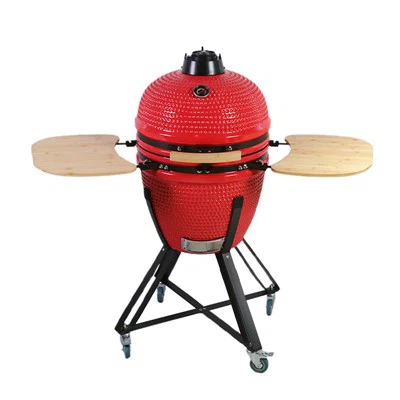
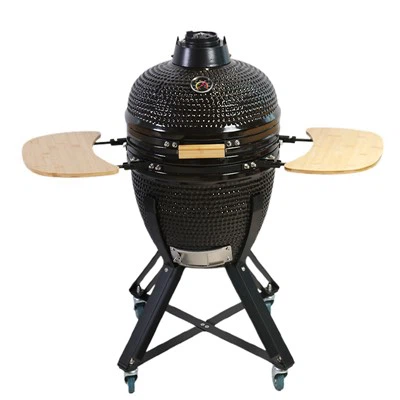
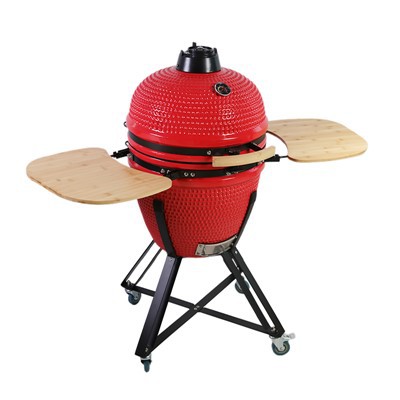
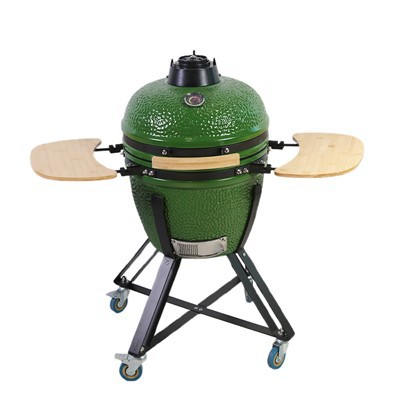
The Kamado Egg Grill is a ceramic-structured, enclosed charcoal cooker, composed of the following functional modules:
Load-bearing Ceramic Shell Body
Double-layer high-density refractory ceramic structure
Typically 18–35 mm thick
For heat storage and radiant conduction
Dome Lid Assembly
Hemispherical structure
Inner ceramic wall reflects heat flow
Airflow Control System
Bottom Air Vent
Top Vent / Chimney Damper
For controlling oxygen input and combustion rate
Cooking System
Cast iron or 304 stainless steel grill rack
Removable Charcoal Basket
Heat Deflector Plate (for indirect heating)
Base Frame
Steel support/caster system
Load capacity ≥ 80–150 kg (depending on model)

How the Kamado Egg Grill Works
The Grill operates based on a natural convection + oxygen-controlled combustion system:
Combustion Process
Charcoal burns in the charcoal basket.
The bottom air inlet controls the amount of oxygen entering.
Oxygen concentration determines combustion intensity (temperature output).
Thermal Circulation Mechanism
The ceramic furnace body absorbs and stores heat energy (Thermal Mass Storage).
Heat is continuously reflected back into the furnace cavity through the inner wall.
This forms a closed-loop heat circulation.
Temperature Control Logic
Bottom Vent = Controls air intake (combustion rate).
Operating Mode Temperature Range Application
Low Airflow 90–120°C Smoking
Medium Airflow 150–250°C Baking
High Airflow 300–450°C Grilling/Grilling
Key Component Details
Key Component Structure & Technical Details


1. Outdoor Catering System
Used in outdoor catering service scenarios, such as mobile food trucks, outdoor banquets, and event catering systems. The equipment typically needs to support continuous high-temperature operation and rapid temperature recovery, suitable for on-site cooking of large quantities of meat or seafood.
2. Restaurant Secondary Grill
Serving as auxiliary grilling equipment in restaurant kitchens, used to divert or supplement the main grill's cooking capacity. Suitable for kitchens requiring simultaneous operation of multiple temperature zones, such as handling both low-temperature smoking and high-temperature grilling processes.
3. BBQ Franchise System
Used in standardized store systems for chain BBQ brands as part of a unified equipment configuration. Its function is to ensure consistency in temperature control, product structure, and cooking time across different stores.
4. Industrial Food Testing Kitchen
Used in kitchen environments for food research and development or process testing, such as testing meat products, seasonings, or new food products. The equipment is used to verify the effects of different temperature profiles on the texture and taste of ingredients.


Installation Procedure:
Base Frame Fixing: Assemble and secure the steel support frame to ensure load-bearing stability before placing any ceramic components.
Main Body Positioning: Lift and position the ceramic cooker body onto the base frame, ensuring level alignment and stable contact points.
Fire Box & Fire Ring Installation: Install the internal combustion chamber components, including the charcoal fire box and supporting fire ring for proper fuel positioning.
Cooking System Assembly: Place the cooking grate and heat deflector plate to configure direct or indirect cooking modes.
Dome Vent Setup: Mount the top airflow vent system and verify smooth opening/closing for exhaust regulation.
Gasket Alignment Check: Inspect and adjust the sealing gasket to ensure airtight closure between dome lid and base body for stable temperature control.
Production Environment


FAQ
Can the Kamado Egg Grill be customized in size or cooking capacity?
Yes. The ceramic body diameter, cooking grid size, and fire box volume can be adjusted based on required cooking capacity. Common customization includes 13", 16", 18", 21", and 23" configurations for different commercial or residential usage scenarios.
What components can be customized in OEM/ODM production?
Customizable parts include ceramic body color (glaze finish), stainless steel vent system, cooking grate material (304 stainless steel or cast iron), logo printing, base frame structure, and packaging design for retail or wholesale distribution.
Is it possible to modify the airflow control system design?
Yes. The top and bottom vent structure can be adjusted for different airflow sensitivity levels, including precision airflow control for low-temperature smoking or wider airflow channels for high-heat grilling applications.
Can the Kamado grill be adapted for commercial restaurant use?
Yes. For restaurant or BBQ franchise systems, structural reinforcement can be applied to the base frame, and continuous-use configurations can be optimized for longer operating cycles, heat retention stability, and higher fuel efficiency.
What packaging and branding options are available for export orders?
Export packaging can be customized with reinforced carton, wooden crate, or pallet structure. Branding options include logo engraving on ceramic body, metal badge labeling, and full OEM packaging design for retail or distributor markets.
Hot Tags: kamado egg grill, China kamado egg grill manufacturers, factory, kamado egg ceramic charcoal bbq, egg shaped bbq smoker, egg shaped barbecue, Portable Kamado Grill, egg shaped ceramic bbq grill, Ceramic Egg Smoker