The global outdoor cooking market continues to create opportunities for BBQ brands, importers, wholesalers, and retail distributors. Among different outdoor cooking products, Kamado grills have attracted attention because of their insulated cooking chambers, adjustable airflow systems, and ability to support multiple cooking methods.
Unlike conventional charcoal grills, a Kamado grill uses a thick insulated body to retain heat and regulate internal temperatures. Depending on its configuration, it can be used for high-temperature grilling, low-temperature smoking, roasting, and baking. These characteristics make it an important product category for outdoor cooking brands targeting residential and premium BBQ markets.
For B2B buyers, choosing a suitable Kamado Grill Manufacturer involves more than comparing product appearance and wholesale prices. Ceramic quality, ventilation design, cooking grate materials, structural components, customization options, and production consistency all affect the final product.
This article introduces 10 notable Kamado grill manufacturers and brands worldwide, examines their product characteristics, and explains the manufacturing considerations buyers should evaluate when developing a wholesale or private-label BBQ product line.
What Makes a Kamado Grill Different?
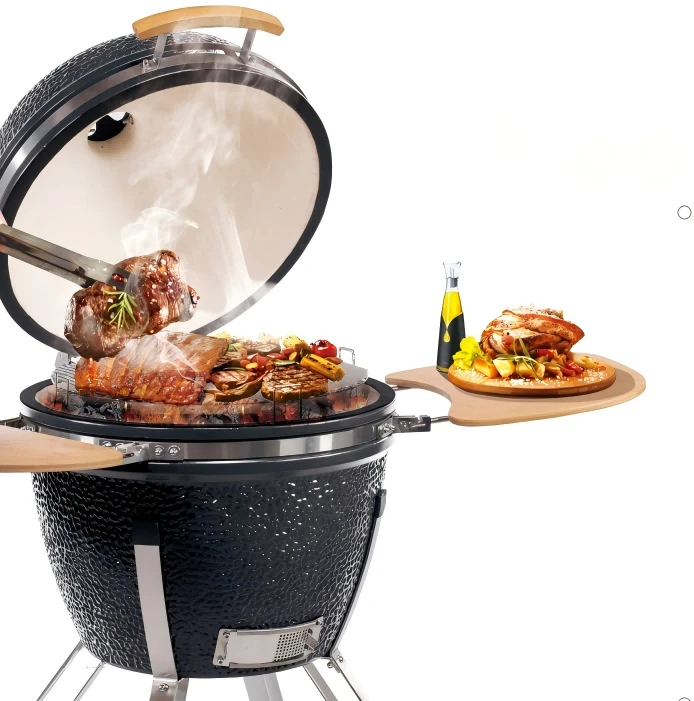
A Kamado grill is a charcoal-fired outdoor cooker characterized by an insulated cooking chamber, usually featuring an egg-shaped or oval body. Traditional models use ceramic materials to retain heat and reduce temperature fluctuations during cooking.
Its performance depends on several interconnected components:
Ceramic Cooking Chamber: Thick ceramic walls absorb and retain heat, helping maintain stable cooking temperatures.
Adjustable Air Vents: Bottom air inlets and top exhaust vents regulate oxygen flow and charcoal combustion.
Charcoal Grate: Supports charcoal while allowing air to circulate underneath the fuel.
Cooking Grate: Provides the surface for grilling meat, vegetables, seafood, and other ingredients.
Heat Deflector: Separates food from direct charcoal radiation for indirect cooking and smoking.
Temperature Gauge: Allows users to monitor the cooking chamber temperature during operation.
The combination of these components allows a Kamado grill to support different cooking applications without requiring separate appliances.
Top 10 Kamado Grill Manufacturers in the World (In No Particular Order )
Website: https://www.bluecarpbbq.com/
Huzhou Blue Carp Co., Ltd. is a Chinese outdoor cooking equipment manufacturer serving importers, wholesalers, distributors, retailers, and private-label BBQ brands.
Its product portfolio includes ceramic Kamado grills, charcoal grills, gas grills, pellet grills, pizza ovens, fire pits, and outdoor heating equipment.
Kamado Product Characteristics
Blue Carp's Kamado grill solutions focus on insulated ceramic cooking structures and controlled charcoal combustion. The cooking system integrates a ceramic chamber, charcoal support, cooking grate, adjustable air vents, and temperature monitoring components.
Its ceramic Kamado range uses high-thermal-retention mullite ceramic structures designed for grilling, baking, and smoking, with a stated operating temperature range from approximately 220°F to above 700°F.
Manufacturing and Customization Capabilities
Blue Carp operates a 50,000-square-meter manufacturing facility equipped with automated production lines. Its production capabilities include metal stamping, laser cutting, welding, coating, component processing, and assembly.
For Business to Business customers, customization can cover:
Grill dimensions and product configurations
Cooking grates and metal components
Product colors and surface finishes
Brand logos and product labels
Retail cartons and protective packaging
OEM and ODM product development
With export experience covering more than 65 countries, Blue Carp supports international buyers developing outdoor cooking product lines for different markets.
For brands seeking a manufacturing partner rather than simply purchasing an established retail product, its combination of Kamado products and broader BBQ manufacturing capabilities provides an option worth evaluating.
Big Green Egg – United States
Big Green Egg is one of the most recognizable names in the Kamado grill market. Its product identity is closely associated with ceramic construction, charcoal cooking, and long-term heat retention.
The company's Kamado grills use insulated ceramic cooking chambers designed to support high-temperature grilling and low-temperature smoking.
Its product ecosystem also includes cooking accessories, heat deflectors, ceramic baking stones, and other components that expand cooking applications.
For Business to Business buyers, Big Green Egg represents an established premium retail positioning with a developed product ecosystem and strong brand recognition.
Kamado Joe – United States
Kamado Joe focuses on premium ceramic Kamado grills with integrated cooking accessories and practical structural innovations.
One of its recognized features is the Divide & Conquer cooking system, which allows users to configure different cooking heights and temperature zones within the same grill.
Other product features include spring-assisted lid mechanisms, adjustable ventilation, and ash-management systems.
Its product development demonstrates how manufacturers can improve traditional Kamado structures through modular cooking components and easier operation.
Primo Ceramic Grills – United States
Primo Ceramic Grills is known for its oval-shaped ceramic Kamado designs.
Compared with conventional round Kamado grills, the oval cooking chamber provides additional flexibility when arranging food and creating direct and indirect cooking zones.
Its product range focuses on ceramic charcoal cooking systems for grilling, smoking, and roasting.
For buyers evaluating Kamado designs, Primo provides an example of how cooking chamber geometry can influence product differentiation and cooking configuration.
Vision Grills – United States
Vision Grills offers ceramic Kamado-style charcoal cookers designed for residential outdoor cooking.
Its product features include adjustable temperature-control systems, assisted lid-opening mechanisms, folding side shelves, and ash-removal components.
The ProZone ventilation system is designed to provide more controlled airflow during cooking.
For Business to Business product development, these features demonstrate the importance of combining thermal performance with convenient operation and maintenance.
Char-Griller – United States
Char-Griller is known for its range of charcoal grills, smokers, and Akorn Kamado-style cookers.
Unlike traditional ceramic Kamado grills, its Akorn models use insulated steel construction.
This design offers a different balance between weight, portability, heat retention, and product cost.
For distributors and retailers, insulated steel Kamado-style grills provide an alternative product category for customers who prefer metal construction over traditional ceramic bodies.
Broil King – Canada
Broil King is an established outdoor cooking brand with a product portfolio covering gas grills, charcoal grills, and Kamado-style cooking equipment.
Its Kamado product development focuses on insulated cooking structures and charcoal-based temperature management.
The brand's broader outdoor cooking range allows retailers to serve different customer segments through multiple grill configurations.
For wholesale buyers, its product positioning provides a reference for comparing insulated metal and ceramic-based outdoor cooking systems.
Blaze Grills – United States
Blaze Grills focuses on premium outdoor cooking equipment, including gas grills, outdoor kitchen products, and Kamado grills.
Its cast-aluminum Kamado construction provides an alternative to conventional ceramic models.
Aluminum construction changes the product's weight and structural characteristics, making material selection an important consideration when comparing Kamado products.
For premium outdoor kitchen projects, Blaze represents a specialized brand targeting buyers interested in integrated outdoor cooking equipment.
Coyote Outdoor Living – United States
Coyote Outdoor Living develops outdoor kitchen and BBQ equipment, including Kamado-style cooking products.
Its product positioning focuses on outdoor kitchen integration, where grills work alongside preparation areas, storage systems, and other outdoor cooking appliances.
For Business to Business buyers, this type of product positioning is relevant when sourcing equipment for outdoor kitchen retailers, residential projects, and premium outdoor living distributors.
Pit Boss – United States
Pit Boss offers a broad outdoor cooking portfolio covering pellet grills, charcoal grills, smokers, and Kamado-style products.
Its presence in the Kamado segment reflects the overlap between traditional charcoal cooking and multi-functional outdoor cooking equipment.
For retailers and distributors, a broad product portfolio can provide opportunities to source different fuel configurations and cooking formats under one established product brand.
Key Technical Features of Kamado Grill Manufacturing
When evaluating a Kamado Grill Manufacturer, Business to Business buyers should examine the product's actual construction and functional components rather than relying only on marketing descriptions.
Ceramic Material and Heat Retention
Ceramic density, wall thickness, and material composition affect the cooking chamber's thermal performance.
A well-designed ceramic structure helps retain heat and reduces temperature fluctuations during extended cooking sessions.
Buyers should request material specifications and thermal performance test information when comparing different suppliers.

Airflow and Temperature Regulation
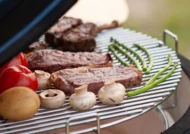
The upper exhaust vent and lower air intake work together to regulate oxygen supply.
Opening the vents increases airflow and can accelerate charcoal combustion, while reducing airflow helps lower the combustion rate.
Vent design, adjustment accuracy, and sealing structure therefore influence temperature management.
Cooking Grates and Metal Components
Cooking grates can be manufactured from stainless steel, cast iron, or other suitable materials.
Stainless steel provides corrosion resistance, while cast iron offers substantial heat retention and surface searing characteristics.
Other important components include hinges, handles, support frames, side shelves, and ash-removal systems.
Material specifications should be confirmed for each component rather than assuming the entire product uses one material grade.
Direct and Indirect Cooking Systems
A Kamado grill can use direct heat for searing and indirect heat for roasting or smoking.
A removable heat deflector changes the heat path between the charcoal chamber and cooking surface.
This component is particularly important for brands developing products aimed at customers who want multiple cooking functions.
How to Choose a Kamado Grill Manufacturer for Wholesale
Before placing a bulk order, importers and distributors should evaluate the following factors.
Product Specifications
Confirm the grill diameter, cooking area, ceramic material, wall construction, temperature gauge, ventilation system, and included accessories.
Manufacturing Capabilities
Check whether the supplier controls product development, component processing, assembly, and quality inspection.
OEM and ODM Customization
Confirm whether the manufacturer can customize product dimensions, colors, logos, accessories, and retail packaging.
Quality Control
Ask for inspection procedures covering ceramic appearance, structural stability, lid alignment, vent operation, cooking grate installation, and packaging condition.
Market Compliance
Determine the applicable requirements for the destination country. Food-contact materials, product safety, labeling, and packaging may require different testing or documentation depending on the market.
Production and Delivery Planning
Request sample lead times, MOQ, production schedules, inspection arrangements, and shipping packaging specifications before confirming an order.
How Blue Carp Supports OEM and ODM Kamado Grill Projects
For private-label BBQ brands, developing a Kamado grill requires coordination between product design, component selection, manufacturing processes, and final packaging.
Blue Carp supports OEM and ODM projects for international outdoor cooking equipment buyers.
Its manufacturing facility covers approximately 50,000 square meters and is equipped with automated production lines for metal processing and product assembly.
The manufacturing workflow can include:
Requirement confirmation and product specification review.
Structural design and 3D CAD evaluation.
Working sample development and functional testing.
Material preparation, cutting, forming, and component processing.
Welding, coating, and assembly.
Sample approval and pilot production.
Mass production inspection and packaging.
For OEM projects, buyers can provide drawings, reference samples, or detailed specifications.
For ODM projects, Blue Carp can assist with product configuration, structural development, material selection, appearance customization, and packaging.
Its published manufacturing workflow lists approximately 15–25 days for working-sample development, depending on project requirements. Standard OEM models across its grill range have a published starting MOQ of 100–300 units; Kamado-specific MOQ and tooling requirements should be confirmed separately.
This manufacturing approach helps buyers evaluate product feasibility before moving into larger production orders.
Frequently Asked Questions
What materials are commonly used in Kamado grills?
Traditional Kamado grills generally use ceramic cooking chambers because of their heat-retention properties. Other components may include stainless steel, cast iron, carbon steel, and heat-resistant hardware.
What temperature range can a Kamado grill reach?
The operating temperature depends on the grill's construction, fuel, airflow, and operating conditions. Some ceramic Kamado configurations support temperatures from approximately 220°F to above 700°F.
Can Kamado grills support OEM and private-label production?
Yes. Depending on the manufacturer's capabilities, customization can include grill dimensions, ceramic colors, metal components, cooking accessories, logos, labels, and retail packaging.
What should buyers inspect before bulk production?
Important inspection points include ceramic body appearance, lid alignment, hinge operation, ventilation adjustment, cooking grate dimensions, component installation, and packaging protection.
How can buyers compare ceramic and metal Kamado grills?
Ceramic models generally emphasize heat retention and traditional Kamado cooking performance. Insulated steel and aluminum models offer different weight, structural, and handling characteristics. Buyers should compare the actual specifications and test results.
Conclusion
The global Kamado grill market includes established premium brands, outdoor cooking specialists, and manufacturers offering different ceramic and metal construction approaches.
For Business to Business buyers, selecting the right supplier requires evaluating more than brand recognition. Ceramic material specifications, airflow regulation, cooking configurations, metal components, production consistency, and customization capabilities all influence the suitability of a product for wholesale distribution.
Huzhou Blue Carp Co., Ltd. combines ceramic Kamado grill products with broader outdoor cooking equipment manufacturing and OEM/ODM services. Its 50,000-square-meter production facility, automated manufacturing lines, and international export experience provide a manufacturing base for buyers developing customized BBQ product ranges.
Whether you are an importer, distributor, retailer, or private-label BBQ brand, defining your target market, product specifications, order quantity, and packaging requirements is the first step toward establishing a workable Kamado grill manufacturing project.