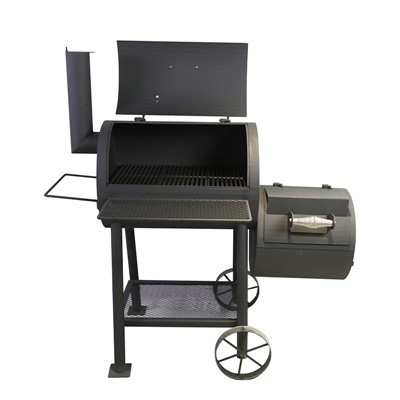
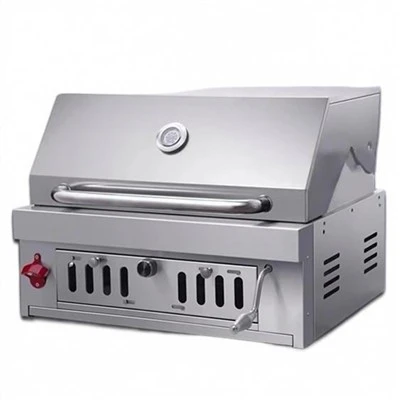
Pellet grills and charcoal grills are two popular options for outdoor cooking, but they use different fuel systems, heat-control methods, and cooking structures. For BBQ brands, importers, wholesalers, and retailers, understanding these differences is essential when selecting products for a target market or developing a private-label grill range.
A pellet grill uses compressed wood pellets and typically relies on an automated feeding system to regulate combustion. A charcoal grill burns lump charcoal or charcoal briquettes, with users controlling heat primarily through airflow and fuel arrangement. These differences influence cooking performance, maintenance requirements, product structure, and customization options.
As a BBQ grill manufacturer, Blue Carp helps business buyers evaluate grill configurations and develop products according to their specifications, target customers, and sales channels.
How Pellet Grills and Charcoal Grills Work
How Does a Pellet Grill Work?
A pellet grill uses compressed wood pellets as its primary fuel. Most conventional designs include a pellet hopper, auger feeding system, combustion pot, ignition component, temperature sensor, and controller.
The process starts when wood pellets move from the hopper into the combustion pot through an auger. An ignition element starts combustion, while a fan supplies air to support burning. On electronically controlled models, the controller reads temperature feedback and adjusts pellet feeding to help maintain the selected cooking temperature.
Many pellet grills use indirect heating and convection to distribute heat through the cooking chamber. This arrangement supports long cooking sessions without requiring the user to manually replenish and rearrange charcoal throughout the process.
However, performance varies by model. Hopper capacity, controller logic, insulation, airflow design, and cooking chamber geometry all influence temperature stability and fuel consumption.
How Does a Charcoal Grill Work?
A charcoal grill uses lump charcoal or charcoal briquettes to generate heat. Its main components typically include a fire bowl or charcoal chamber, charcoal grate, cooking grate, lid, adjustable air vents, and an ash collection system.
Air enters through the lower vents and supports charcoal combustion. Hot air and combustion gases move through the cooking chamber before exiting through the upper vent or other exhaust openings. Adjusting airflow, fuel quantity, and charcoal placement changes the intensity and distribution of heat.
Charcoal grills can support both direct and indirect cooking. Placing food above the main charcoal bed creates direct heat exposure, while moving the fuel to one side allows food to cook in a cooler zone.
For manufacturers, charcoal grill performance depends on the relationship between the fire bowl, charcoal tray, ventilation openings, lid structure, and cooking grate position.
Key Differences Between Pellet Grills and Charcoal Grills
Although both products are designed for outdoor cooking, their structures serve different operating requirements.
| Comparison | Pellet Grill | Charcoal Grill |
|---|---|---|
| Fuel | Compressed wood pellets | Lump charcoal or charcoal briquettes |
| Fuel delivery | Usually automated through an auger | Manually loaded and arranged |
| Ignition | Commonly uses an electric igniter | Commonly uses a chimney starter or fire starter |
| Temperature control | Digital controller on equipped models | Primarily manual airflow and fuel adjustment |
| Heating method | Commonly indirect heat and convection | Direct radiant heat or indirect heat |
| Cooking style | Smoking, roasting, and extended cooking | Grilling, searing, roasting, and smoking |
| Power requirement | Conventional models require electricity | Many basic models operate without electricity |
| Maintenance | Ash, grease, and mechanical or electronic components | Ash, grease, grates, and ventilation components |
These differences do not mean one grill is suitable for every application. A well-designed charcoal grill can maintain controlled temperatures for smoking, while some pellet grills include high-temperature searing features. Buyers should evaluate the specifications of each model rather than rely on fuel type alone.
Temperature Control and Cooking Performance
Pellet Grill Temperature Control
The main advantage of an electronically controlled pellet grill is reduced manual fire management. The user selects a target temperature, and the control system regulates pellet delivery according to temperature feedback.
Important design factors include:
Temperature sensor placement: Sensor location affects how accurately the controller represents cooking chamber conditions.
Auger feeding rate: Fuel delivery influences combustion intensity and the controller's response to changing heat demand.
Combustion airflow: Fan performance affects oxygen supply and pellet combustion.
Cooking chamber design: Insulation, lid fit, and internal airflow influence heat loss and temperature distribution.
Controller configuration: Different control systems produce different temperature response and fluctuation patterns.
For B2B buyers, these specifications are more useful than a general claim that a grill provides precise temperature control. Ask manufacturers for the available temperature range, control functions, probe configuration, and performance data for the specific model.
Charcoal Grill Heat Management
Charcoal grills provide more direct user control over the fire. Adjusting the lower air intake changes the oxygen supply, while the upper damper influences exhaust flow. Moving charcoal closer to or farther from the cooking grate also changes the heat intensity received by the food.
Several structural features affect this process:
Adjustable charcoal tray height
Air intake and exhaust damper design
Cooking grate position
Fire bowl dimensions
Lid fit and heat retention
Ash collection and removal structure
A height-adjustable charcoal tray, for example, allows users to change the distance between the fuel bed and the cooking grate. This can support different heat levels without changing the overall grill footprint.
For brands developing a custom charcoal grill, these structural details can be specified according to the intended cooking style and target retail price.
Flavor and Cooking Applications
Wood Smoke and Pellet Grilling
Pellet grills use wood-based fuel, allowing the type and composition of the pellets to influence the smoke profile. The resulting flavor also depends on combustion conditions, cooking temperature, food type, and exposure time.
Their automated operation makes pellet grills suitable for:
Beef brisket
Pork shoulder and pulled pork
Pork ribs
Whole chicken
Fish and vegetables
Roasting and selected baking applications
For long cooking sessions, automated feeding can reduce the need for frequent manual fuel adjustments. However, the achievable cooking temperature and direct-flame capability depend on the specific design.
Charcoal Flavor and Direct Grilling
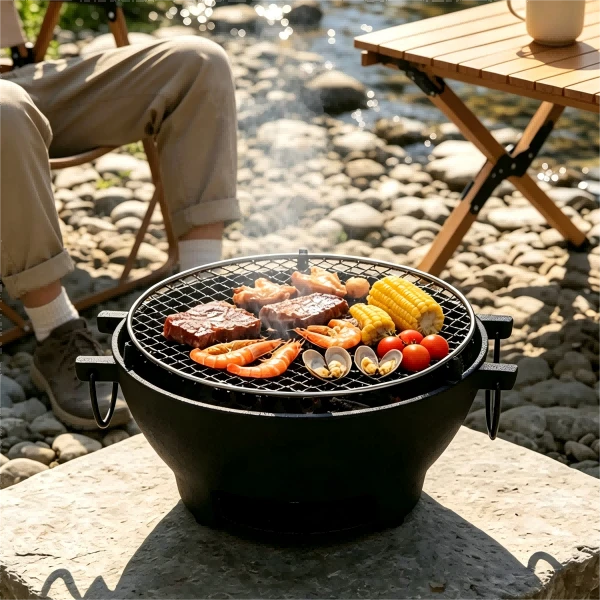
Charcoal grills are well suited to direct grilling because the fuel bed can deliver strong radiant heat. Food juices and fats may also drip onto hot charcoal or other hot surfaces, producing additional smoke and grilled aromas.
Common applications include:
Steaks and burgers
Sausages and kebabs
Grilled vegetables
Whole chicken and roasts
Indirect cooking for ribs and larger cuts of meat
Smoking when the grill is configured for controlled airflow and extended cooking
Adding suitable wood chunks or wood chips can introduce additional wood-smoke characteristics. The final flavor depends on the fuel, combustion conditions, cooking setup, and food preparation.
For product development, the important question is not which grill produces the best flavor in every situation. It is whether the product's heating structure matches the cooking experience expected by the target customer.
Cleaning and Maintenance Requirements
Pellet grills contain more fuel-handling and electrical components than a basic charcoal grill. Routine maintenance may include removing ash from the combustion pot, cleaning grease trays, inspecting the auger and fan, and checking the temperature sensor and ignition component.
Pellet storage also matters. Wood pellets should be kept dry to reduce moisture absorption, swelling, and feeding problems.
Charcoal grills generally have fewer powered components, but they still require regular cleaning. Users need to remove ash, clean cooking grates, inspect ventilation openings, and maintain the charcoal tray and exterior surfaces.
For manufacturers, maintenance should be considered during product design. Accessible ash collection systems, removable grease trays, serviceable components, and practical cleaning access can improve the product's long-term usability.
Surface treatment, material selection, and the construction of high-heat components should also match the intended operating conditions and maintenance requirements.
How to Choose the Right Grill for Your Market
For BBQ importers, wholesalers, retailers, and private-label brands, product selection should start with the target customer and intended sales channel.
Choose pellet grills when your market prioritizes:
Automated fuel feeding and temperature management
Long-duration smoking and roasting
Digital controls and optional temperature probes
A product offering positioned around convenience and controlled cooking
Choose charcoal grills when your market prioritizes:
Traditional charcoal grilling
Direct-heat searing and hands-on cooking
Simple operating mechanisms on basic models
Flexible fuel placement and cooking-zone configuration
Purchase price, shipping dimensions, assembly requirements, material specifications, packaging, and local compliance requirements should also be evaluated before finalizing a product range.
Retail brands may prioritize appearance, ease of assembly, and packaging dimensions. Outdoor cooking specialists may focus more on cooking area, temperature management, fuel capacity, and structural features. Commercial buyers may require different dimensions, access arrangements, or cooking configurations.
The appropriate product specification should reflect these requirements rather than treating every grill as a standard catalog item.
Custom Pellet Grill and Charcoal Grill Manufacturing by Blue Carp
Blue Carp supports BBQ brands, importers, distributors, wholesalers, and retailers seeking standard products or customized outdoor cooking equipment. Our OEM and ODM services allow buyers to define product requirements beyond logo placement, including structural configuration, material selection, functional components, surface finishes, and packaging.
Pellet Grill Customization
Depending on the selected model and project requirements, customization may cover:
Product dimensions: Overall size, cooking chamber configuration, and cooking area.
Fuel system: Hopper configuration and feeding system specifications.
Temperature control: Controller options, probe configuration, and available functions.
Cooking structure: Cooking grates, racks, and internal layout.
Appearance: Selected colors, finishes, handles, and exterior details.
Branding and packaging: Logo placement, product labels, instructions, and private-label packaging.
These options need to be assessed against the product's technical requirements, tooling needs, and target production cost. Not every option is available on every model.
Charcoal Grill Customization
For charcoal grill projects, buyers can specify product features such as:
Grill body dimensions and cooking surface area
Charcoal tray design and adjustable height
Air intake and exhaust damper configuration
Cooking grate materials and layout
Lid structure, handles, wheels, and side shelves
Steel specifications and surface treatment
Logo, color, labels, and export packaging
Blue Carp's manufacturing processes cover metal fabrication, cutting and forming, welding, surface treatment, component processing, assembly, and quality control. These capabilities support the development of grill structures according to agreed product specifications.
From Product Requirements to Mass Production
A custom grill project should begin with a defined product brief. This includes the intended market, fuel type, cooking applications, target dimensions, material preferences, functional requirements, estimated order volume, and packaging needs.
The development process can then proceed through:
Requirement confirmation: Define the product configuration and buyer specifications.
Design and engineering review: Evaluate the structure, components, manufacturing feasibility, and cost implications.
Prototype and sample evaluation: Check the sample against agreed functional and dimensional requirements.
Specification approval: Confirm the final configuration, materials, finish, branding, and packaging.
Mass production and inspection: Manufacture against the approved specification and inspect relevant product and packaging characteristics.
This process helps buyers align product design with manufacturing requirements before committing to bulk production.
Whether you are developing a pellet grill with digital controls or a charcoal grill with an adjustable cooking grate, the objective is to establish a clear specification that can be evaluated, manufactured, and reproduced.
Blue Carp works with B2B buyers to turn product requirements into practical BBQ grill manufacturing projects. Share your drawings, reference samples, target specifications, or initial concept to discuss the appropriate OEM or ODM approach for your product range.