What Are Backyard Grills?
At Blue Carp, we manufacture outdoor cooking equipment for brands, wholesalers, retailers, importers and distributors. In the backyard grill market, product selection is not determined by appearance alone. Fuel type, cooking structure, material, size, mobility and temperature-control requirements all affect the final grill configuration.
Based on these manufacturing and application factors, Backyard Grills can be divided into several major product categories, including charcoal grills, gas grills, kamado grills, smoker grills, pellet grills and fire pit grills.
For buyers developing a private-label BBQ product line, understanding these structural differences is important before deciding on dimensions, materials, accessories and production specifications.
10 Common Types of Backyard Grills
Kettle Charcoal Grill
A kettle charcoal grill normally uses a round cooking chamber with a lid, charcoal grate and cooking grate. The enclosed structure can support both direct and indirect grilling.
For manufacturers, the key development points include body diameter, lid structure, vent configuration, grate material and support frame.
Portable Charcoal Grill
Portable charcoal grills use a smaller cooking chamber and compact support structure for outdoor activities such as camping, picnics and travel.
When developing this type of product, we focus on overall dimensions, product weight, folding or detachable structures, packaging volume and handling requirements.

Kamado Grill
A kamado grill generally uses a thick-walled cooking chamber designed to retain heat. Its structure can support grilling, roasting and low-temperature cooking.
For OEM projects, buyers may specify the cooking chamber size, exterior finish, stand, cooking grate configuration, ventilation components and accessory package.
Charcoal Smoker Grill
A charcoal smoker combines charcoal combustion with controlled smoke exposure. Compared with a basic charcoal grill, its internal structure places greater emphasis on airflow and cooking-chamber configuration.
Manufacturing considerations include firebox design, cooking chamber dimensions, air vents, grate positions and access doors.
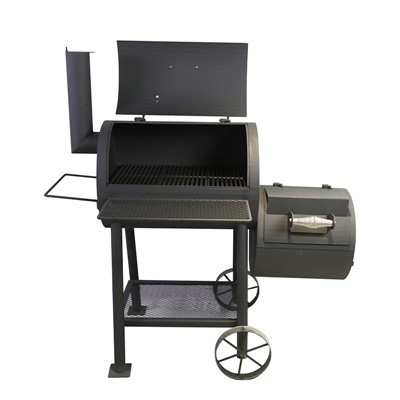
Offset Smoker Grill
An offset smoker normally separates the firebox from the main cooking chamber. Heat and smoke travel from the side firebox into the cooking chamber before exiting through the exhaust system.
The relationship between firebox volume, cooking chamber size and airflow passages is therefore an important part of product development.
Pellet Grill
Pellet grills use wood pellets as fuel and typically integrate a pellet feeding mechanism and temperature-control system.
For private-label development, the mechanical system, hopper capacity, cooking area, electrical components, control interface and housing structure need to be evaluated together.
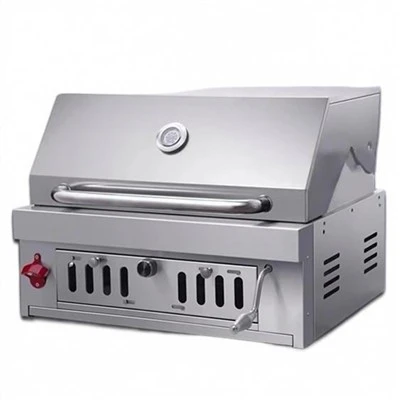
Gas Grill
Gas grills use propane or natural gas as the primary fuel source. Compared with charcoal products, gas grills generally focus more heavily on burner configuration, ignition, heat distribution and control components.
Depending on the target product range, manufacturers can develop different burner layouts, cooking areas, lid structures and cabinet configurations.
Freestanding BBQ Grill
A freestanding BBQ grill combines the cooking chamber with an independent support frame. The structure can be designed for patios, gardens, balconies and other outdoor cooking areas.
For production, the frame, wheels, side shelves, storage structure and cooking chamber need to be coordinated to achieve the required product dimensions and packaging configuration.
Cart-Style Grill
Cart-style grills integrate the grill body with a wheeled cart structure. This configuration provides space for storage, accessories and side working areas.
From a manufacturing perspective, the cart dimensions, wheel configuration, frame strength, storage space and assembly method directly affect production and shipping requirements.
Fire Pit Grill
Fire pit grills combine outdoor fire functionality with a cooking surface. Depending on the design, the product may use charcoal or wood as fuel.
The main development considerations include fire bowl construction, cooking grate dimensions, support structure, heat-resistant materials and outdoor-use requirements.
How We Select the Right Grill Structure
At Blue Carp, we do not treat every backyard grill as the same product with a different appearance. Different applications require different structural configurations.
For example, a portable charcoal grill prioritizes compact dimensions and handling. A smoker requires controlled airflow and separation between the fire source and cooking chamber. A gas grill requires space for burners, ignition components and heat distribution.
Before production, we evaluate:
Fuel type
Cooking chamber dimensions
Cooking grate size
Body and frame structure
Airflow requirements
Temperature-control components
Mobility requirements
Surface treatment
Assembly structure
Packaging dimensions
This allows us to match the product structure with the buyer's intended market and application.
Materials and Manufacturing Considerations
Material selection affects product weight, surface finish, structural strength, heat resistance and manufacturing cost.
For metal Charcoal Grills, steel is commonly used for the main body and supporting structure. Surface treatment can then be selected according to the required appearance and application.
For example, one of our compact charcoal grill configurations uses a steel grill body and wind shield with an enamel coating, combined with a chrome-plated steel cooking grate.
The product uses a three-position adjustable cooking grate and a triangle support structure, demonstrating how relatively simple mechanical components can be integrated into a compact backyard grill.

OEM & ODM Backyard Grill Manufacturing
Backyard grill buyers often need more than an existing catalog model. Retailers and outdoor cooking brands may require customized dimensions, colors, structures, packaging or branding.
Our OEM and ODM manufacturing scope can cover:
Product Structure
Grill body dimensions
Cooking chamber configuration
Support structure
Cooking grate position
Wheels and mobility components
Material & Finish
Steel components
Cooking grate materials
Surface treatment
Product color
Exterior finish
Brand Customization
Logo
Product labeling
Color matching
Packaging
Carton artwork
Product Development
For ODM projects, buyers can start from an existing Blue Carp grill structure and modify selected components according to their target market. For OEM projects, we can work from customer drawings, specifications or product requirements.
How Blue Carp Supports Custom BBQ Grill Projects
As an outdoor cooking equipment manufacturer, Blue Carp approaches BBQ grill development from both product and manufacturing perspectives.
A typical project can move through several stages:
Requirement → Product Structure → Material Selection → Prototype → Testing → Sample Approval → Mass Production → Packaging
At the initial stage, we review the target product type, fuel source, cooking area, dimensions and market positioning defined by the buyer.
After the basic structure is confirmed, engineering requirements can be translated into components and production specifications. Sample production then allows the buyer to evaluate the physical product before moving toward larger-volume manufacturing.
This process is particularly useful for importers, wholesalers, retailers and private-label brands developing their own Backyard Grill range.
FAQ
What types of backyard grills does Blue Carp manufacture?
Our outdoor cooking product range can cover charcoal grills, kamado grills, smoker grills, gas grills, pellet grills, fire pit grills and other BBQ equipment configurations.
Can Blue Carp customize backyard grills?
Yes. OEM and ODM projects can be developed around product dimensions, structures, materials, surface finishes, colors, branding and packaging requirements.
Can I customize an existing charcoal grill design?
Yes. An existing Blue Carp model can be used as a starting point for an ODM project. Specific dimensions, components, finishes and packaging can then be evaluated according to the project requirements.
What should buyers provide for a custom grill project?
The most useful information includes the target grill type, fuel type, approximate dimensions, cooking area, material requirements, target market, branding requirements and estimated order quantity.
Conclusion
The backyard grill market includes multiple product structures rather than one standardized grill configuration. Kettle charcoal grills, portable charcoal grills, kamado grills, smoker grills, offset smokers, pellet grills, gas grills, freestanding grills, cart-style grills and fire pit grills each require different manufacturing considerations.
At Blue Carp, we use product structure, material selection and production requirements as the basis for OEM and ODM development. This allows buyers to develop customized BBQ grills according to their product specifications instead of simply selecting a fixed catalog model.