How a Charcoal Grill Works
As a charcoal grill manufacturer, we understand that a backyard grill is more than a steel body with a cooking grate. Its performance depends on the relationship between the fuel, airflow, cooking chamber, grate position and heat distribution.
Charcoal generates heat when it burns with an adequate supply of oxygen. The airflow entering and leaving the grill therefore affects combustion intensity and cooking temperature. Adjustable vents or dampers are commonly used to regulate this airflow. More air can increase combustion, while restricting airflow can reduce the burning rate.
This is why we consider ventilation openings, charcoal placement, cooking grate height and chamber geometry during product development.
For different backyard grills, the same charcoal fuel can produce very different cooking results depending on how these components are configured.
Direct Heat, Indirect Heat and Dual-Zone Cooking
One of the most important differences between charcoal grilling methods is how the charcoal is positioned relative to the food.
Direct Heat
With direct heat, food is positioned directly above the burning charcoal. The high radiant heat is suitable for foods that require relatively short cooking times, such as burgers, steaks and vegetables.
The position of the cooking grate is therefore important because the distance between the food and charcoal affects the intensity of heat received by the food.
Indirect Heat
For indirect cooking, the charcoal and food are separated. The food is placed away from the main charcoal bed while hot air circulates inside the covered cooking chamber.
This configuration can be used for longer cooking processes such as roasting and smoking. A heat deflector or separated charcoal arrangement can help create this cooking zone.
Dual-Zone Cooking
Dual-zone cooking combines these two methods in one grill.
The charcoal is placed on one side of the charcoal basin, creating:
Direct Zone → High Heat
Indirect Zone → Lower, Indirect Heat
This allows users to sear food over direct heat and then move it to the indirect zone for slower cooking. From a manufacturing perspective, a sufficiently large cooking surface, appropriate charcoal placement and a suitable grate structure are important for supporting this configuration.
Choosing the Right Charcoal Grill Structure
We develop charcoal BBQ products according to their intended installation and application.
Freestanding Charcoal Grill
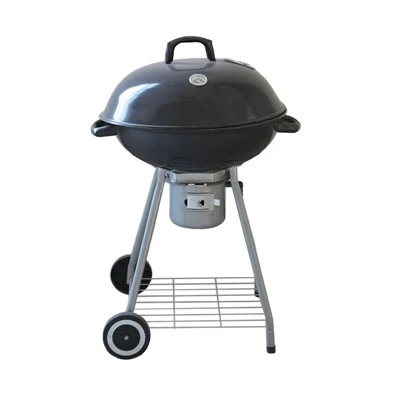
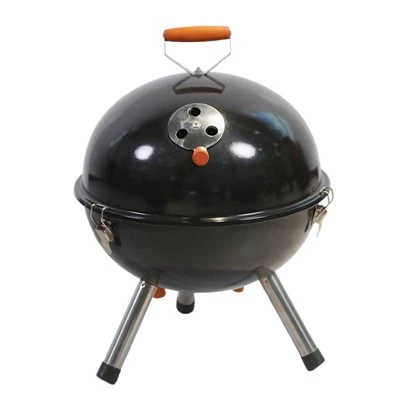
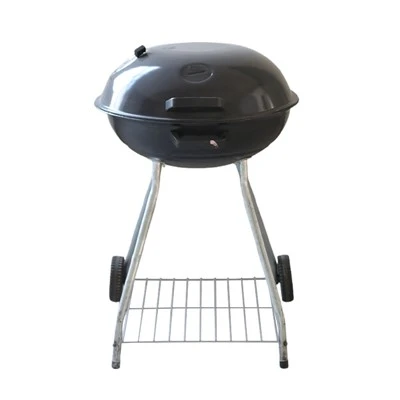
Freestanding models can use legs or a cart structure. They are suitable for backyard cooking and applications where the grill needs to be moved.
A freestanding structure also makes ash removal and maintenance more accessible than a permanently installed grill.
Built-In Charcoal Grill
Built-in charcoal grills are designed for outdoor kitchen installations. Their dimensions and ventilation requirements need to be coordinated with the surrounding BBQ island.
For OEM projects, installation dimensions become an important part of the product specification.
Kamado Grill
Kamado grills use a different construction principle from conventional steel charcoal grills. Ceramic walls provide insulation and help retain and radiate heat, while restricted airflow contributes to heat retention and moisture retention during cooking.
Charcoal Smoker
A charcoal smoker focuses more heavily on low-temperature cooking, smoke circulation and longer cooking times. The firebox, cooking chamber, vents and internal airflow therefore require a different design approach from a compact charcoal grill.
Grill Size and Cooking Area
When buyers select a charcoal grill, cooking area should not be evaluated only by the number of people served.
A larger cooking surface can provide additional space for different heat zones. For example, charcoal can be concentrated on one side while the remaining cooking area is used for indirect cooking.
BBQGuys categorizes small charcoal grills as cooking surfaces up to approximately 26 inches wide, medium models around 27–33 inches, and large models at 34 inches or wider. These dimensions provide a useful reference, but the appropriate size still depends on the intended application and cooking configuration.
For product development, we therefore evaluate:
Cooking grate dimensions
Number of users
Direct and indirect cooking requirements
Charcoal capacity
Product footprint
Storage and transportation requirements
Materials and Cooking Grate Selection
Material selection affects the weight, appearance, thermal behavior, corrosion resistance and production cost of a charcoal grill.
Steel is widely used for conventional charcoal grill bodies because it is suitable for forming, welding and different surface treatments.
Stainless steel can be selected for applications requiring a more corrosion-resistant outdoor structure. Ceramic is commonly associated with Kamado grills because of its insulating characteristics.
The cooking grate is another important component. Depending on the product design, manufacturers can evaluate chrome-plated steel, stainless steel or other grate configurations according to the target market and product requirements.
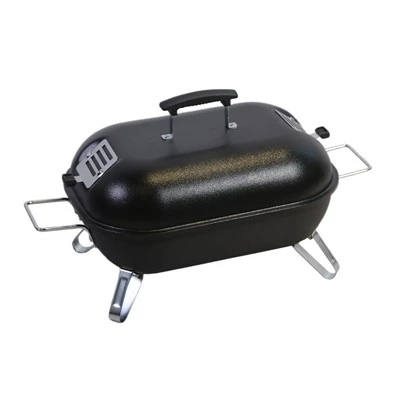
For example, our compact charcoal grill configurations can combine a steel body with an enamel surface treatment and a chrome-plated steel cooking grate.
The objective is not simply to select a material with a higher specification. We match the material and surface treatment with the product's intended use, manufacturing process and target cost.
Airflow and Temperature Control
A charcoal grill does not use a gas-burner control knob. Temperature management relies heavily on airflow and charcoal management.
During product development, we consider:
Air Inlet → Charcoal Bed → Cooking Chamber → Exhaust
The position and adjustability of vents can affect how air moves through the grill.
Cooking grate height can provide another method of controlling the distance between food and charcoal. Adjustable-height grates can allow users to move food closer to or farther away from the heat source.
For this reason, airflow openings, dampers, grate height and charcoal placement should be considered as an integrated system rather than isolated features.
Charcoal and Ash Management
Charcoal grills generate ash during combustion. If ash accumulates inside the lower section of the grill, it can affect airflow and make cleaning more difficult.
A well-designed product may therefore include:
Charcoal tray
Charcoal basket
Ash pan
Ash drawer
Removable ash container
Charcoal access door
These components can improve maintenance and make it easier for users to add, rearrange or remove charcoal.
For manufacturers, ash management is also a structural consideration because the collection system must fit within the available grill body while maintaining sufficient airflow around the charcoal.
OEM & ODM Charcoal Grill Manufacturing
As a charcoal grill factory, Blue Carp works with buyers who may need an existing product configuration or a customized BBQ grill developed around specific requirements.
Our OEM and ODM development can cover:
Product Structure
Grill body dimensions
Cooking chamber configuration
Cooking grate size
Adjustable grate positions
Charcoal tray
Ash management system
Support structure
Wheels and mobility components
Material & Surface
Steel
Stainless steel
Enamel coating
Other specified surface finishes
Cooking grate material
Branding & Packaging
Logo
Product label
Product color
Packaging artwork
Carton design
Private-label packaging
This allows importers, wholesalers, retailers and outdoor cooking brands to develop a product according to their target market instead of relying only on standard catalog specifications.
How Blue Carp Develops Custom BBQ Grills
At Blue Carp, our manufacturing process starts with the product requirement rather than the appearance.
We first define the intended application:
Backyard BBQ → Fuel Type → Cooking Area → Grill Structure → Material → Surface Treatment → Components → Packaging
After the basic specification is established, the product structure can be developed around the cooking method and manufacturing requirements.
For example, a compact charcoal grill may prioritize a smaller footprint, simple support structure and adjustable cooking grate. A larger charcoal smoker requires a different relationship between the firebox, cooking chamber and exhaust system.
This manufacturing approach allows us to develop OEM and ODM charcoal grills for different product categories, market requirements and retail positioning.
FAQ
What should buyers consider when selecting a charcoal grill?
The main considerations include fuel type, cooking area, grill structure, airflow control, cooking grate configuration, charcoal capacity, ash management and intended cooking method.
What is the difference between direct and indirect charcoal grilling?
Direct grilling places food above the charcoal for higher direct heat. Indirect grilling separates the food from the charcoal and uses circulating heat for longer cooking processes.
Why is airflow important in a charcoal grill?
Charcoal combustion depends on oxygen. Adjustable vents and dampers help regulate airflow through the grill, which affects combustion intensity and temperature.
Can Blue Carp customize charcoal grills?
Yes. Blue Carp supports OEM and ODM development covering grill dimensions, structure, materials, surface treatment, cooking grate configuration, branding and packaging.
Conclusion
A modern charcoal grill is a combination of combustion, airflow, heat transfer and mechanical structure. Cooking performance depends not only on the charcoal itself, but also on how the grill controls airflow, positions the fuel, manages the cooking grate and distributes heat.
At Blue Carp, we use these technical factors as the foundation for BBQ grill development. From compact backyard charcoal grills to larger charcoal smokers and customized outdoor cooking equipment, we can work with buyers to translate product requirements into manufacturable structures and production specifications.
For importers, wholesalers, retailers and private-label BBQ brands, this approach provides a practical starting point for developing a customized Backyard Grill with defined specifications rather than simply changing the appearance of an existing product.