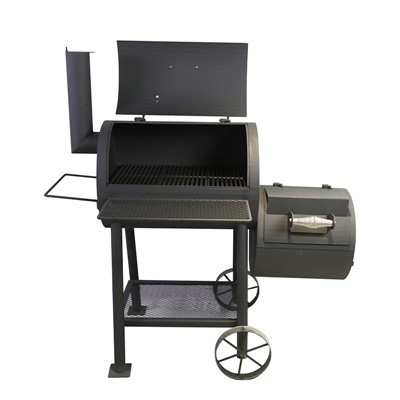
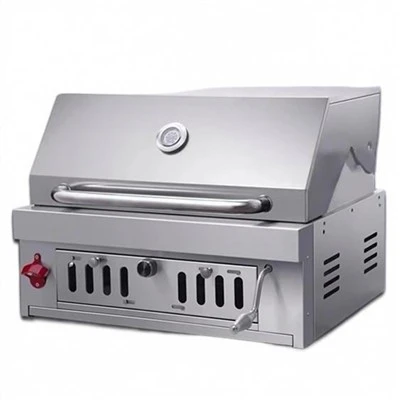
Can the manufacturer develop our own charcoal grill design?
For a BBQ brand, private label manufacturing should go beyond adding a logo to an existing product. The right Charcoal Grill Manufacturer should be able to convert your product concept, drawings or market requirements into a manufacturable product.
Blue Carp supports the development process from product concept and structural design to prototyping, sample confirmation and mass production. Buyers can define requirements such as cooking area, grill size, lid structure, ventilation system, charcoal tray, wheels, handles and accessories.
This approach helps solve a common problem: a product may look attractive in a drawing but become expensive or difficult to manufacture at scale. By reviewing the structure before mass production, the design can be adjusted for manufacturing efficiency, assembly time, material usage and shipping volume.
What can be customized for a private label BBQ brand?
A private label customer usually needs more than a custom logo. Depending on the project, customization can cover product dimensions, structure, color, surface finish, handles, wheels, cooking grates, charcoal management components, temperature gauges, logos and retail packaging.
For example, a brand targeting premium backyard cooking may prioritize appearance and cooking-area design, while an e-commerce brand may focus more on compact packaging and lower shipping volume.
Blue Carp works with buyers to match product configuration with the intended sales channel instead of simply offering the same factory model to every customer.
How should MOQ and production capacity be evaluated?
MOQ should be evaluated together with expected sales volume, inventory turnover and container efficiency.
For a new BBQ brand, ordering too much inventory can tie up working capital. Ordering too little may increase unit cost and make production less efficient. Therefore, buyers should compare MOQ, production capacity, lead time and container loading quantity before placing a bulk order.
Blue Carp operates a large-scale BBQ manufacturing facility with approximately 100,000 m² of production space, 300 workers and more than 200 automated machines, supporting large-volume OEM/ODM programs.
The goal is not simply to quote a low MOQ. It is to establish an order quantity that balances unit cost, production efficiency, inventory risk and shipping cost.
How can mass-production quality be controlled?
For a private label brand, the biggest quality risk is often not the first sample. It is the difference between the approved sample and thousands of production units.
A professional quality-control process should cover incoming materials, welding, surface treatment, component assembly, functional inspection, final inspection and packaging.
For charcoal grills, buyers should pay particular attention to welding consistency, lid alignment, grate dimensions, ventilation components, wheel installation, surface finish and assembly accuracy.
Blue Carp's production system is designed around repeatable manufacturing rather than one-off sample production, helping brands maintain consistent product specifications throughout bulk orders.
What materials and construction should buyers specify?
Material selection directly affects the grill's weight, durability, heat resistance, appearance and manufacturing cost.
Before ordering, buyers should clarify the steel type, material thickness, grate material, coating or surface treatment and key structural components.
The correct specification depends on the target market and product positioning. A portable charcoal grill, for example, has different weight and structural requirements from a large cart-style backyard grill.
Blue Carp can work with buyers to evaluate material and structural requirements according to the intended application and target price, rather than selecting materials only according to the lowest initial cost.
Can the manufacturer support testing and market compliance?
Different markets and sales channels may impose different product-testing, labeling and documentation requirements. This becomes particularly important when a BBQ brand plans to sell through major retailers or international e-commerce channels.
Before production, buyers should confirm which testing reports, product documentation, labeling requirements and inspection procedures are required for their destination market.
Blue Carp can coordinate the manufacturing and quality process around the buyer's specified market requirements, reducing the risk of discovering compliance issues after production has already started.
How should packaging and container loading be optimized?
For large charcoal grills, packaging is part of the product cost.
A grill with excellent factory pricing can still become commercially unattractive if the carton is oversized or inefficiently packed. Buyers should therefore evaluate carton dimensions, gross weight, packaging structure, assembly requirements and 40HQ loading quantity together.
For e-commerce brands, reducing package volume can also influence fulfillment and last-mile logistics costs. For retail customers, retail-ready packaging, barcode placement, assembly instructions and product protection may be equally important.
Blue Carp can review packaging together with the product structure so that the finished product is designed not only for manufacturing, but also for transportation and retail distribution.
Can the factory support spare parts and after-sales service?
A charcoal grill is a long-term-use product. Components such as cooking grates, handles, wheels, charcoal trays and other replaceable parts may eventually require replacement.
For a brand owner, this means after-sales support directly affects customer reviews and brand reputation.
Before placing a bulk order, buyers should ask the manufacturer about spare-part availability, component identification, replacement procedures and warranty handling.
Blue Carp can work with private label customers to establish a suitable spare-parts and after-sales structure according to the product configuration and sales market.
Why Choose Blue Carp for Private Label Charcoal Grill Manufacturing?
Choosing a Private Label Charcoal Grill Manufacturer is ultimately a supply-chain decision, not simply a product-price decision.
A suitable factory needs to connect product development, material selection, manufacturing, quality control, packaging, logistics and after-sales support into one process.
Blue Carp combines large-scale BBQ manufacturing capabilities with OEM/ODM support for international brands. With approximately 100,000 m² of production space, 300 workers and more than 200 automated machines, the factory is equipped to support both product development and volume production.
For a BBQ brand preparing a new product line, the better question is therefore not:
"Who can manufacture this charcoal grill at the lowest price?"
It is:
"Who can help us develop a commercially viable product, control quality during mass production, optimize logistics and continue supporting the product after launch?"
That is the difference between buying a charcoal grill and building a private label BBQ product line with a manufacturing partner.