What Is a Kamado Grill?
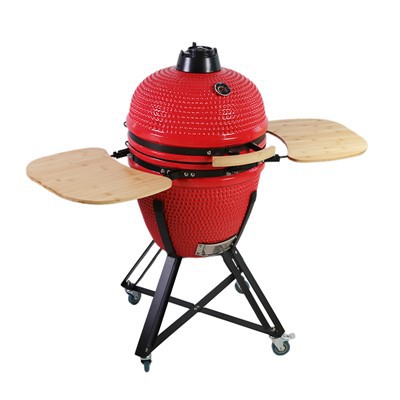
A kamado grill is a charcoal-fired cooker recognized by its thick-walled body, domed lid, enclosed cooking chamber, and adjustable air vents. Its design combines the functions of a traditional charcoal grill, a barbecue smoker, and an outdoor oven in one cooking appliance.
Unlike an open charcoal grill, a kamado controls how air enters the fire chamber and how heat and smoke circulate around the food. This enclosed structure helps maintain cooking temperatures over extended periods, making it suitable for both high-temperature grilling and low-temperature smoking.
The body of a traditional kamado is commonly made from ceramic, while modern designs may use steel or other metal materials. The choice of construction affects heat retention, weight, durability, portability, and the overall product cost.
For outdoor cooking brands, retailers, importers, and distributors, understanding these differences is essential when evaluating product specifications and target markets.
Blue Carp approaches BBQ grill development from a manufacturing and product-application perspective. For B2B buyers planning to expand their outdoor cooking ranges, the first step is to define the intended cooking methods, target users, construction requirements, and retail positioning before finalizing a grill design.


How Kamado Grill Construction Controls Heat
A kamado grill relies on three interacting factors: heat storage, controlled airflow, and circulation inside the cooking chamber.
2.1 Insulated Cooking Chamber
The thick body of a kamado absorbs heat from burning charcoal and releases it gradually into the cooking space. This thermal mass helps reduce rapid temperature changes when the lid remains closed.
Ceramic is particularly effective at retaining heat because of its insulating properties. Metal models behave differently depending on the material, wall thickness, insulation, and internal construction.
For long cooking sessions, heat retention can reduce the frequency of fuel replenishment. It also helps maintain a more stable environment for smoking larger cuts of meat.
2.2 Direct and Indirect Heat
Direct cooking exposes food to radiant heat from the charcoal below. This arrangement is appropriate for steaks, burgers, sausages, and other foods that benefit from surface browning.
Indirect cooking introduces a heat deflector between the fire and the food. Instead of receiving intense direct radiation, the food cooks through the circulation of heated air inside the closed chamber.
This configuration supports roasting, slow smoking, and baking. Depending on the grill's internal layout, accessories may also allow users to create separate cooking zones for different foods.
2.3 Fuel Consumption and Cooking Duration
A well-insulated kamado can maintain cooking temperatures with a relatively controlled charcoal supply because less heat escapes through the body and lid.
Actual fuel consumption depends on several operating conditions, including ambient temperature, wind exposure, vent settings, charcoal type, cooking temperature, and the frequency of opening the lid.
Blue Carp considers these practical operating factors important when helping B2B buyers evaluate grill specifications. Product performance should be assessed under defined cooking conditions rather than described through general claims about efficiency.
Ceramic vs. Metal Kamado Grills
The body material is one of the most important decisions in kamado grill development. Ceramic and metal constructions offer different combinations of thermal performance, handling requirements, and durability.
3.1 Ceramic Kamado Grills
Ceramic is traditionally associated with kamado cooking. Its insulating properties help the cooking chamber retain heat during prolonged smoking and roasting sessions.
Key characteristics include:
Strong heat retention for maintaining relatively stable cooking temperatures.
Suitability for low-and-slow barbecue and indirect cooking.
A substantial body that is generally heavier than comparable metal construction.
Sensitivity to impact, sudden mechanical stress, and improper handling.
Ceramic grills require careful transportation, assembly, and everyday operation. Dropping the body or closing the lid forcefully can cause cracking. Repeated thermal cycling may also contribute to material deterioration over time.
Cleaning procedures must account for the specific ceramic and coating system. Harsh liquid chemicals and lighter fluid should not be used on porous ceramic surfaces unless the manufacturer explicitly confirms compatibility.
For buyers targeting consumers who prioritize traditional kamado performance, ceramic construction offers a recognizable product proposition. Packaging protection, lid support, firebox design, and handling instructions should also be considered during product development.
3.2 Metal Kamado Grills
Metal kamados provide an alternative for buyers seeking different weight, structural, or manufacturing characteristics.
Steel and aluminum constructions can be easier to handle than thick ceramic bodies, although the actual weight depends on the design and material thickness. Metal structures are also less susceptible to the type of impact cracking associated with ceramic.
However, metal performance varies by alloy, coating, insulation, and component design.
Steel requires appropriate corrosion protection, particularly around exposed edges, fasteners, joints, and areas affected by heat or moisture. Aluminum can offer corrosion resistance, but its performance depends on the alloy and operating environment.
Metal bodies may transfer heat differently from ceramic, so insulation, wall construction, lid fit, and airflow control become important engineering considerations.
For Blue Carp's B2B customers, selecting a material should begin with the intended selling price, expected usage frequency, transportation requirements, and maintenance expectations. These factors provide a more useful basis for product decisions than material choice alone.
Understanding Airflow and Temperature Regulation
Airflow is central to kamado operation because charcoal combustion requires oxygen. Most designs use an adjustable lower intake vent and an upper exhaust vent to regulate the movement of air through the cooking chamber.
4.1 Lower Air Intake
The lower vent controls the amount of fresh air reaching the charcoal. Opening it further generally supplies more oxygen and can increase combustion, while restricting the opening can reduce the rate of burning.
Adjustments should be gradual because the grill body and charcoal continue to store heat even after airflow is reduced.
4.2 Upper Exhaust Vent
The upper vent allows hot air and combustion gases to leave the chamber. Its opening works together with the lower intake to influence airflow and temperature.
The two vents should be designed for practical adjustment and repeatable positioning. Loose fittings, unstable vent settings, or poor alignment can make temperature management more difficult.
4.3 Temperature Monitoring
A built-in thermometer gives users a convenient indication of the cooking chamber's temperature. However, the temperature at the lid may differ from the temperature near the cooking grate or inside the food.
For more precise cooking, users can employ grate-level probes and food-temperature sensors. Digital controllers and fan-assisted airflow systems may also be considered where the grill design supports them.
For manufacturers and private-label buyers, vent geometry, lid sealing, thermometer placement, and control accessibility are important design-review points. Their effectiveness should be verified through prototype testing and repeated cooking trials.
What Can You Cook on a Kamado Grill?
The combination of direct heat, indirect heat, and a covered cooking chamber gives kamado grills a broad range of applications.
5.1 High-Temperature Grilling
With the heat deflector removed, food can be positioned above the charcoal for direct cooking. This setup is suitable for steaks, burgers, chicken portions, vegetables, and other foods that benefit from a browned exterior.
Cooking grate material, grate spacing, and usable cooking area influence how comfortably users can handle different food sizes.
5.2 Low-and-Slow Smoking
For smoking brisket, pork shoulder, ribs, and other large cuts, the grill operates at a lower, controlled temperature over an extended period.
The enclosed chamber helps retain heat and circulate smoke around the food. Suitable charcoal, wood chunks, stable airflow, and a properly fitted lid all contribute to the cooking environment.
Because long smoking sessions are sensitive to temperature fluctuations, users should avoid unnecessary lid opening and monitor cooking conditions throughout the process.
5.3 Roasting and Baking
A heat deflector can separate food from direct flame, turning the cooking chamber into an enclosed oven-like environment.
With suitable accessories and temperature control, users can roast whole chickens, cook casseroles, bake bread, or prepare pizza. The required setup depends on the recipe, food thickness, cooking temperature, and desired surface finish.
For buyers developing accessories or bundled grill products, compatibility between the cooking grate, deflector, rack system, and lid clearance should be checked before production.
Key Factors When Selecting a Kamado Grill
Choosing a kamado grill requires more than comparing its external dimensions or advertised cooking temperature. Buyers should evaluate the complete product configuration.
6.1 Cooking Area and Grill Shape
The cooking area determines how much food can be prepared in one session. A compact round grill may suit smaller households or limited outdoor spaces, while a larger cooking surface can accommodate family gatherings and more substantial cuts.
Oval designs can provide additional space for certain food shapes and may support dual-zone cooking when the internal configuration allows it.
6.2 Installation and Mobility
Freestanding models with suitable carts are designed for outdoor placement and may be repositioned when necessary. Cart stability, wheel locking, handle placement, and access to ash-removal areas all affect usability.
Built-in models require more careful planning. Buyers should consider the outdoor kitchen layout, ventilation, maintenance access, and required clearances from combustible materials.
Installation must follow the grill manufacturer's instructions and applicable local safety requirements.
6.3 Lid, Hinge, and Sealing Components
A heavy lid needs a stable hinge system and a handle that can be operated safely. On ceramic designs, a suitable lid-assist mechanism can reduce the force required during opening and closing.
The sealing interface also matters because gaps can alter airflow and make temperature regulation less predictable.
During product evaluation, buyers should check lid alignment, hinge movement, fastener security, gasket fit, and repeated opening-and-closing performance.
6.4 Cleaning and Maintenance
Ash accumulation can restrict airflow and interfere with combustion. A removable ash collection system or accessible firebox can simplify routine cleaning.
Exterior protection, corrosion-resistant fittings, suitable covers, and clear maintenance instructions can also influence long-term ownership experience.
For commercial buyers, these details should be included in product specifications and inspection criteria rather than treated as minor accessories.
Kamado Grill Accessories and Functional Design
Accessories can expand the cooking applications of a kamado, but they must fit the grill's dimensions and thermal environment.
Heat deflectors create an indirect cooking zone by separating food from direct exposure to charcoal.
Cooking grates provide the main food-support surface. Material selection, diameter, thickness, and surface finish affect cleaning and handling.
Raised racks and multi-level systems increase usable cooking positions and can help separate foods that require different levels of heat.
Thermometers and temperature probes help users monitor the cooking chamber and food temperatures.
Ash-management components make it easier to remove combustion residue and maintain clear airflow paths.
Carts, side shelves, and protective covers support placement, food preparation, storage, and outdoor protection.
For OEM and ODM projects, accessory compatibility should be reviewed alongside the grill itself. Dimensions, mounting positions, material specifications, packaging protection, and replacement-part availability all influence the final product configuration.
Blue Carp: OEM & ODM Solutions for BBQ Grill Buyers
Blue Carp works with B2B customers seeking BBQ grill manufacturing and product customization for their own brands, retail programs, and distribution channels.
For buyers researching kamado grills, a successful sourcing project begins by translating market requirements into a clear product brief. The required material, cooking area, operating configuration, accessories, appearance, and packaging should be defined before manufacturing specifications are finalized.
8.1 Product Requirements and Design Review
Blue Carp's OEM/ODM project approach can begin with the buyer's target market, intended user group, preferred product category, and reference specifications.
The review can cover body construction, cooking grate layout, lid operation, airflow controls, surface finish, accessory requirements, and packaging needs. Where a project involves a specific kamado design, the proposed construction and production feasibility must be confirmed before the product is committed to mass production.
8.2 Customization for Private-Label Brands
B2B buyers may require differences in appearance, product configuration, branding, and retail presentation.
Depending on the confirmed product design and manufacturing scope, customization discussions can cover:
Product appearance: Color, exterior finish, handles, and brand presentation.
Functional configuration: Cooking grate arrangement, vent controls, lid hardware, and compatible accessories.
Material specifications: Body material, metal components, coatings, and corrosion-protection requirements.
Branding: Logo placement and product identification.
Packaging: Retail presentation, protective inserts, product labeling, and export packaging requirements.
Final customization options depend on the product structure, tooling requirements, material availability, order quantity, and technical feasibility.
8.3 Prototype Evaluation and Quality Control
Before mass production, buyers should confirm the approved specifications and establish measurable inspection requirements.
Depending on the product, evaluation may include dimensional checks, assembly fit, lid alignment, hinge operation, vent movement, surface finish, coating quality, packaging protection, and functional cooking tests.
For kamado products, thermal performance and structural safety require particular attention. Ceramic models need suitable impact protection and careful handling procedures. Metal models require assessment of heat exposure, corrosion protection, and component stability.
Blue Carp's OEM/ODM cooperation process can be aligned with the buyer's approved drawings, sample requirements, inspection plan, and packaging specifications. Specific testing arrangements and production capabilities should be confirmed for each project.
8.4 Manufacturing Cooperation for B2B Buyers
Blue Carp serves businesses that need a manufacturing partner to coordinate product requirements, customization, and supply preparation.
The intended customer may be a BBQ brand developing a private-label range, an importer sourcing products for a regional market, a distributor expanding its outdoor cooking category, or a retailer planning a differentiated product assortment.
Clear communication about target pricing, expected order volume, destination-market requirements, packaging dimensions, and delivery schedules helps establish a practical production plan.
Start Your OEM Project with Blue Carp. Share your product concept, target specifications, customization requirements, and purchasing plan to discuss the next steps for your BBQ grill project.
Frequently Asked Questions About Kamado Grills
Q1. What makes a kamado grill different from a conventional charcoal grill?
A kamado uses an enclosed, insulated cooking chamber and adjustable intake and exhaust vents. This design supports more controlled cooking temperatures and allows users to switch between direct grilling, indirect roasting, smoking, and baking.
Q2. Is ceramic or metal better for a kamado grill?
Neither material is automatically better for every application. Ceramic offers strong heat retention but is heavy and vulnerable to impact damage. Metal construction can reduce handling weight and provide different structural options, but performance depends on insulation, alloy selection, coatings, and component design.
Q3. Can a kamado grill be used for smoking and baking?
Yes. Low-temperature smoking uses controlled charcoal combustion and airflow, while baking generally requires indirect heat through a suitable deflector. The correct configuration depends on the food, target temperature, and grill design.
Q4. What should B2B buyers confirm before ordering customized BBQ grills?
Buyers should establish the product specification, construction materials, dimensions, functional requirements, branding, accessories, packaging, order quantity, inspection criteria, and delivery expectations. For a kamado-specific project, production feasibility and thermal-performance testing should also be confirmed.
Q5. Does Blue Carp provide OEM and ODM customization?
Blue Carp offers OEM/ODM cooperation for BBQ grill buyers. The available customization scope, technical feasibility, production arrangements, and order requirements should be confirmed according to the specific product and project brief.
Conclusion
A kamado grill is a versatile charcoal cooker whose performance depends on the relationship between body construction, heat retention, airflow regulation, cooking configuration, and accessory design.
For B2B buyers, product selection should be based on the intended application, material properties, functional requirements, maintenance needs, and target market. These factors also form the foundation of a well-defined OEM/ODM project.
Blue Carp helps BBQ grill buyers approach product development through requirement review, customization planning, specification confirmation, and manufacturing coordination. By defining technical expectations before production, brands and distributors can develop product offerings that better match their market requirements.