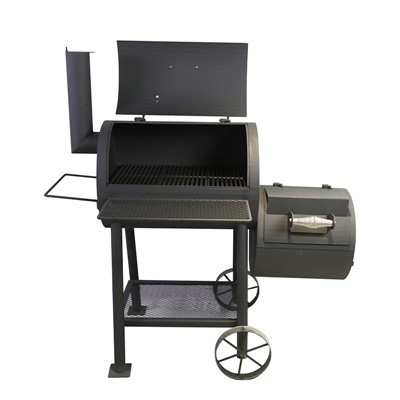
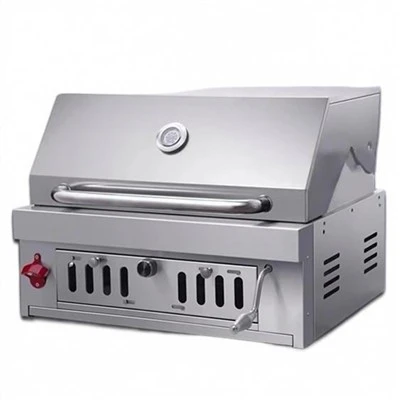
Heat distribution is a key factor in the cooking performance of a Charcoal BBQ Grill. A grill may reach a high maximum temperature but still produce uneven cooking if heat is concentrated in one area, airflow is poorly controlled, or the cooking grate is too close to the charcoal. The thermal behavior of the grill body must therefore be considered together with the firebox, ventilation system, grate structure, and fuel arrangement.
Effective heat management allows users to create high-heat areas for searing and lower-temperature areas for slower cooking. From a product design and purchasing perspective, the objective is not simply to generate more heat, but to provide a controllable heat pattern that can be adjusted according to the cooking task.
What Impacts Heat Distribution on Charcoal BBQ Grills?
Heat inside a charcoal grill is transferred mainly through radiation, conduction, and convection. Glowing charcoal produces radiant heat that directly affects food and surrounding surfaces. The cooking grate transfers heat through contact, while hot air moves through the cooking chamber by convection.
The main variables can be viewed as a combined thermal system:
| Variable | What Changes | Typical Result |
|---|---|---|
| Charcoal placement | Location of the fuel bed | Shifts hot zones |
| Charcoal quantity | Available fuel and combustion intensity | Changes overall heat output |
| Air intake | Oxygen supplied to charcoal | Changes combustion rate |
| Exhaust | Hot-gas movement and draft | Influences airflow |
| Steel thickness | Thermal mass | Affects thermal response |
| Firebox geometry | Heat and airflow paths | Can create local temperature differences |
| Grate design | Contact area and heat retention | Changes conductive heating |
| Grate height | Distance from charcoal | Changes radiant heat exposure |
| Ash accumulation | Available airflow | Can reduce combustion |
Steel thickness is only one part of the equation. Greater thermal mass can influence temperature response and heat retention, but it does not independently guarantee uniform heating. Fuel arrangement, ventilation, geometry, grate construction, and outdoor conditions remain important when evaluating a charcoal barbecue grill.
How Charcoal Placement and Airflow Create Different Heat Zones
The simplest way to understand charcoal heat control is to follow the relationship between fuel position, oxygen supply, and heat concentration.
Charcoal concentrated in one area
stronger direct radiant heat above the fuel
high-temperature cooking zone
Charcoal spread across the firebox
broader heat coverage
more uniform direct cooking area
Charcoal concentrated on one side + fuel-free area
direct and indirect zones
food can be moved according to cooking stage
Airflow then determines how intensely the charcoal burns. Opening an intake generally increases oxygen supply and combustion intensity, while restricting it slows the burn. The exhaust also matters because hot gases need a defined path out of the cooking chamber. Blocked vents or accumulated ash can interfere with this process.
How Grate Design and Distance Affect Heat Distribution
The cooking grate forms the interface between the heat source and the food. Its material, mass, rod diameter, spacing, and geometry influence how heat is transferred and retained at the cooking surface.
| Grate Consideration | What It Influences |
|---|---|
| Cast iron | Thermal mass and surface heat retention |
| Stainless steel | Corrosion resistance and maintenance |
| Grate thickness | Heat retention and thermal response |
| Rod diameter | Contact area and heat capacity |
| Grate spacing | Food support and airflow around food |
| Grate height | Radiant heat exposure |
Distance provides another method of controlling heat. A grate positioned closer to the charcoal receives stronger radiant heat, while raising it reduces direct exposure. Adjustable grate height can therefore provide a mechanical method of changing cooking intensity without changing the charcoal quantity. This is particularly useful when the grill needs to support both high-temperature searing and slower cooking.
Improving Heat Distribution: A Practical Adjustment Sequence
When heat distribution is uneven, changing several variables simultaneously makes it difficult to determine the cause. A staged adjustment process is more useful:
1. Check the fuel bed - Confirm whether charcoal is concentrated too heavily in one area or blocking airflow.
2. Check airflow - Inspect the intake and exhaust openings and make gradual adjustments to combustion intensity.
3. Check grate distance - Raise or lower the cooking surface if the design allows adjustment.
4. Redistribute the heat - Move charcoal, food, or both to reduce localized hot spots.
5. Test again - Use a thermometer or a simple toast test to compare temperatures across the cooking surface.
Heat shields, baffles, charcoal partitions, and ash-management components can also be incorporated into the grill design when the target application requires more controlled heat separation. These features can help create distinct cooking areas without relying solely on fuel quantity.
Heat Management for Different Cooking Tasks
Different foods do not require the same heat pattern. The objective is therefore not necessarily to make every point on the grate identical, but to provide usable temperature zones.
| Cooking Task | Heat Pattern | Useful Control |
|---|---|---|
| Steaks and skewers | High direct heat | Concentrated charcoal |
| Burgers | Medium to high heat | Two-zone setup |
| Chicken and fish | Moderate or indirect heat | Distance + airflow |
| Large cuts | Low and indirect heat | Fuel layout + controlled airflow |
| Finishing after searing | Moderate indirect heat | Move food away from direct charcoal |
For example, a thick cut can be exposed to direct heat for surface browning and then moved to an indirect zone to continue cooking. This requires a grill layout that allows food to move between zones rather than relying on one fixed temperature.
How to Find and Correct Hot Spots
A hot spot is not always obvious from the appearance of the charcoal. The cooking surface can be tested by placing bread or toast across different grate positions and comparing the browning rate. Faster browning indicates greater heat exposure at that location.
If one area consistently runs hotter, the cause may be uneven charcoal distribution, differences in airflow, firebox geometry, grate position, or ash accumulation. The correction can then be targeted rather than based on guesswork.
Test → Identify → Adjust → Retest
This approach can be used during product development as well as normal operation. For manufacturers and buyers, it provides a practical way to evaluate whether a Charcoal BBQ Grill produces a usable heat pattern rather than simply checking its maximum temperature.
What Should Buyers Check Before Purchasing?
For B2B buyers, heat distribution should be evaluated as a combination of product specifications and functional design.
Material and structure
- Actual steel thickness
- Firebox dimensions
- Internal partitions or baffles
- Structural connections
Heat-control system
- Adjustable air intake
- Exhaust configuration
- Charcoal separation
- Adjustable grate positions
Cooking surface
- Grate material
- Grate thickness
- Rod diameter and spacing
- Cooking-surface area
Maintenance
- Ash removal
- Access to airflow passages
- Cleaning access
- Replacement of functional components
The key question is whether these components work together to provide controllable direct and indirect heat. A thicker steel body or larger charcoal capacity alone does not tell a buyer how evenly or predictably a charcoal barbecue grill will distribute heat.
Huzhou Blue Carp Co., Ltd. for Charcoal Grill Manufacturing
Huzhou Blue Carp Co., Ltd. manufactures outdoor cooking and living equipment, including charcoal, gas, electric, pellet, and ceramic grills, pizza ovens, griddles, fire pits, and outdoor heating products. Its charcoal grill manufacturing capabilities cover metal fabrication, cutting and forming, welding, surface treatment, component processing, assembly, quality inspection, and bulk production.
For Charcoal BBQ Grill projects, these capabilities support the fabrication and assembly of fireboxes, grates, vents, and structural components, with QC covering dimensions, welds, lid alignment, grate and charcoal-tray installation, vent operation, surface finish, assembly, and packaging. OEM/ODM specifications can be defined by material, dimensions, structure, grate, ventilation, surface treatment, logo, packaging, quantity, and destination-market requirements.